
Human beings were exploiting and despising other groups of people thousands of years ago, before the time of written history. As societies became involved in land ownership and war, they conquered and captured other people and forced them into slavery. Records of slavery began in approximately 6800 BC in Mesopotamia. The Egyptians mounted expeditions along the Nile and captured and enslaved people. The Roman Empire and Athens in ancient times were very reliant on slaves.
In the late 15th and early 16th centuries Europeans were increasingly exploring the earth and meeting people they had never come across before. From then on they invented the concept of racial hierarchy, based on skin colour and physical attributes and used their theories to justify making use of these ‘other’ peoples, capturing and exploiting them and then subjecting them to the horrors of the Atlantic Slave Trade. Religious and scientific justification for this exploitation, including eugenics, followed, and then institutional racism developed and became entrenched in subsequent years, especially in the 19th and 20th centuries. This led to segregation, marginalisation and lasting inequality in many parts of the world. Racism became increasingly prevalent and was used to defend western imperialism and the consequent exploitation and mistreatment of ‘other’ groups.
Racism was especially prevalent during the second half of the last century and was thought to have declined since. Sometimes new groups are the main focus of racists. Racism against Gypsy, Roma and Traveller people is now widespread and Muslims have reported an increase in racist behaviour towards them. And police figures released in the autumn last year reveal an alarming rise in hate crimes. Religious hate crimes against Muslims were up by 19%. As assaults increase in number, many have the sense that hatred has become normalised.
The right has increasingly targeted some minority groups and blames Muslims, migrants and refugees for the economic problems in the UK.
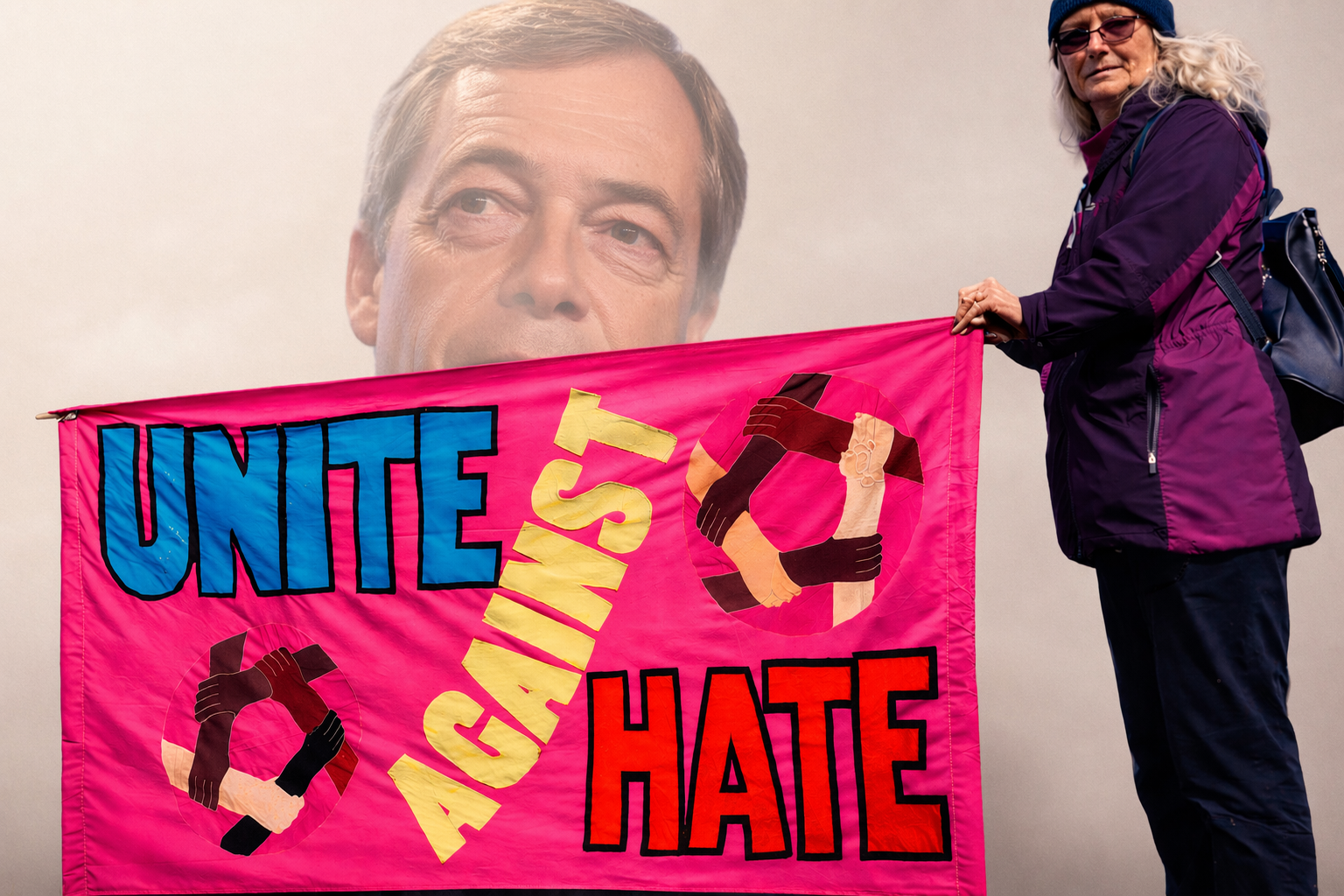
And now we have a political party, one that has become increasingly popular with the electorate, led by a known racist, Nigel Farage. There is evidence of his racist behaviour when he was at school at Dulwich College and he has described Enoch Powell as his idol. He brought a fringe party, the UK Independence Party (UKIP), into the political mainstream and achieved considerable success in elections between 2013 and 2015. He has increasingly focused on immigration.
But Farage and his supporters are not the only threat. Stephen Christopher Yaxley-Lennon has become a well known name in the UK as Tommy Robinson. He has had a chequered past and has led or been involved in a number of racist groups over the years. He has had trouble with the law and spent time in prison yet manages to enjoy a lavish lifestyle. When protests in Epping erupted over the use of a hotel as accommodation for asylum seekers, Yaxley-Lennon stoked tensions. He has been an enthusiastic supporter of numerous far right demonstrations. He has many supporters, and can attract significant numbers. Early this year, Robinson had a popularity rating of approximately 24% among the British public, according to YouGov’s popularity tracker, although almost half the population expressed dislike. In September 2025 he organised a far right “Unite the Kingdom” rally in London and it was reported that between 100,000 and 150,000 joined the event.
We have a history of mobilising against racists in this country and on Saturday 28 March there was a huge demonstration in London, described by the ‘Together Alliance’ as the largest anti-far-right march in British history, involving an estimated half a million people. It was widely reported in the UK press and overseas.
The march had a common purpose, though many participating groups and individuals are concerned about and campaign about a number of developments in this country and elsewhere. In addition to the increasing boldness among supporters of the far right in their public expressions of hate and division, we are subject to greater surveillance, our right to protest is being restricted and large corporations and billionaires have increased their control of our politicians. As Amnesty International, one of the participants in Saturday’s event, stated: “The UK is entering a period of political uncertainty, resulting in rising far-right hostility and violence towards migrants and racialised communities, shrinking civic space and deepening political polarisation.”
A large area of London was brought to a standstill as a huge united peaceful crowd of all ages and backgrounds from across the country converged on Whitehall. The demonstration aimed to send a message of hope and unity in defiance of the divisive messages from the far right.
A number of well-known figures could be seen amongst the crowds and approximately 500 groups supported the march. They included trade unions, antiracism campaigners, Muslim representative bodies, Jewish groups, an immigrants and refugees bloc and environmentalists. There was also a separate march for Palestine which joined everyone else in Hyde Park. Small groups who opposed the march and its aims appeared once or twice, but the numbers were few and they were very unimpressive despite the huge loudspeakers they used to make themselves sound powerful.
The march was characterised by diversity, friendliness, peacefulness and cooperation and a sense of inspiration and hope as we saw how many different people from so many different walks of life had come together in unity. As Amnesty pointed out, “When we act together, we are powerful.”
Discover more from Penumbrage
Subscribe to get the latest posts sent to your email.
[…] Nigel Farage framed the disorder in Belfast as an inevitable consequence of a system he describes as having “broken borders.” He claimed that leave to remain is handed out “like smarties,” and announced that a Reform UK government would ban visas for anyone from Sudan with the clear implication that everyone from Sudan is a risk. […]