
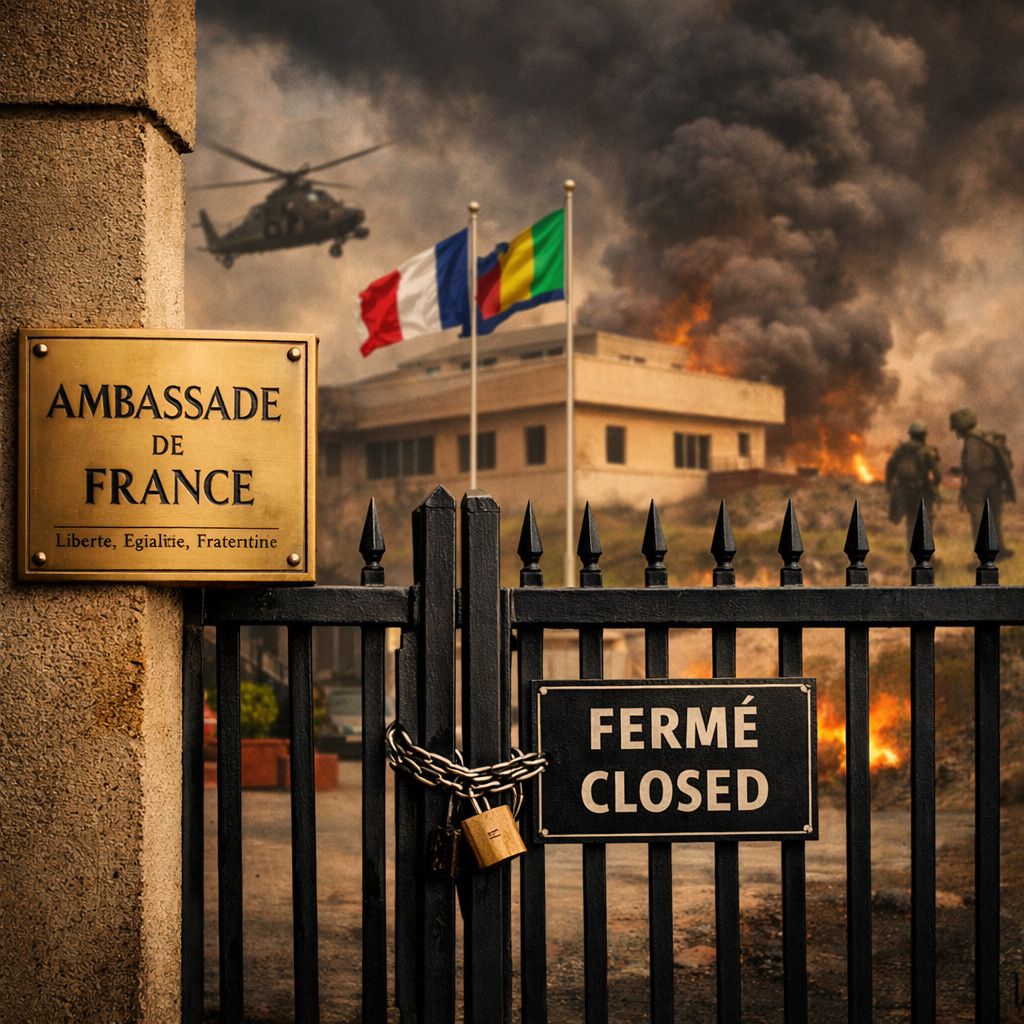
Mali
The landlocked African nation, Mali, is one of the poorest countries on earth. It has a history of coups and attempted coups. Around half the population lives below the national poverty line. Their situation is exacerbated by armed conflict and climate change. Both of these lead to instability in other countries in the Sahel, characterised by violent extremism and weak governments.
The ruling junta in Mali, headed by military leader Gen Assimi Goïta, has been threatened by insurgents, and some high ranking officers in the military and politicians are alleged to be conspiring against the government and colluding with these insurgents. Recently the junta has had to concede territory to them. The government in Bamako appears threatened and less stable at the moment.
The west has been alarmed by the spread of militancy and has increased its involvement.
There are estimated to be between 4,000 and 7,000 French nationals living in Mali. France has urged them to leave and, along with the UK, has advised against all travel to Mali.
Many of us know little about the history of Mali but it is one of many examples of instability as the country deals with its colonial legacy. France ruled the country from 1892 until 1960. This led to a number of structural problems such as artificial borders, which divided communities and where the north was marginalised. The economy was focused on resources for France, which did not benefit local people, including gold, cotton and peanuts, and labour. Post-independence, this created systemic inequalities, fueling chronic conflicts, military coups, and ethnic tensions.
As always in war, civilians are suffering and are being killed in the conflict. Women and children are among the dead. Three years ago the UN proposed an investigation into war crimes carried out by the government forces and their Wagner group backers. And now Mali seems close to civil war which will bring death, disease, hunger and displacement to the people of Mali.
Shock therapy: war forces oil-addicted Asia to finally go green
The above is a heading from the South China Morning Post. However, before President Donald Trump initiated the war against Iran, the publication Energy Tracker reported in January that Asia would dominate renewable energy investment in 2026. However, the war has shown that the transition to renewable energy is imperative as the world cannot continue its level of dependency on fossil fuels. Ramnath Iyer, sustainable finance lead of Asia, Institute for Energy Economics and Financial Analysis, commented, “Policymakers really have every incentive at this point in time to accelerate the move toward renewables … and to make more ambitious plans to switch to renewable”. There is also the potential to increase energy independence and security by making use of local indigenous renewable energy resources.
A great deal could be achieved in the coming months alone, given the political will and with hands being forced because of the unreliability of fossil fuels, to turn to renewables for the sake of the planet. The dangers of reliance on oil has certainly been highlighted in recent weeks. No one would condone this shameful war. Indeed military activity and war add approximately 5.5% to 6% to total global greenhouse gas emissions.This is equivalent to being the planet’s fourth largest emitter. However this destruction and devastation may encourage us to understand increasingly that renewables are vital and must be the way forward. This understanding must lead to action.
The kiss of death from glyphosate
While many fields in the countryside are suffering from lack of rain and may look dry, some go on to turn yellow and then brown and eventually silver. Before planting takes place any competing growth must be removed by clearing the fields. Farmers can either plough the fields, which costs £25 per acre, or spray them with glyphosate at a cost of £15. More and more glyphosate is being used in the UK. There has been a 1000% increase since 1900. Glyphosate finds its way into our cereals and vegetables, into our tap water and into the rain. Added to this, plastic film is used to warm the soil and boost growth early on. Since 2021 only biodegradable film has been allowed in the EU, but not here. We use film which breaks down into microplastics and adds to our plastic pollution. We cannot blame the farmers; we need different policies when it comes to food production. But, until then, our health and our planet remain under threat.
Is a River Alive?
Last year Robert MacFarlane published a book called Is a River Alive?. MacFarlane believes “rivers are life-forces, not only resources, and increasingly environmentalists are seeing rivers as living entities.” He is most concerned about the pollution, misuse and destruction of rivers and, after travelling to experience the life in them, he concluded, “Rivers are easily wounded, but given a chance they heal themselves with remarkable speed. Their life pours back and with it ours too.” This echoes the approach of Connecting Threads, “a creative project responding to the River Tweed, its habitats, ecologies, communities and culture”. Creating Threads is a five-year project which extends for 97 miles. The river is considered a “living presence”. In partnership with local people all along the Tweed, there are plans underway, including a project to construct a walking and cycling trail along the river, opening in 2028. One of the developments will be “a group of creative practitioners across diverse art forms, with conservationists, environmentalists, scientists, river specialists and communities of place and purpose, celebrating the River Tweed through a sustained programme of cultural activity”. A sense of cooperation and community spirit is becoming increasingly strong as diverse interest groups come together to celebrate the Tweed and its long history, to promote creativity and protect this living waterway.
Crane Park café
Earlier this year, a local community in a quiet corner of Twickenham rallied round in support of Diaco Yari, the Iranian owner of a coffee van called Thirst for All, after a mugging by five men resulted in the theft of all his earnings for that day and a broken tooth. Locals started a fundraiser to help him. Diaco said, “I really appreciate the people. I didn’t know people recognised me working here. That was very nice. And the day after the incident, everyone came to say sorry and they showed me appreciation.”
The coffee van has become something of a hub for local people who meet and chat, often with their dogs in tow. Fundraiser Mandy said, “There’s never been anything like this anywhere around here and this is a community that’s been built purely on the basis of this man’s coffee and a chat. We would protect him to the end of the earth.” She added, “You just realise that this man, he’s just like a little angel, like God’s angel really. He’s so kind.” One couple adopted Diaco and he is reported to have saved the life of someone slipping into the River Crane.
The local community has shown us all how asylum seekers can contribute to their communities and how support for them can create lasting friendships. For Diaco this piece of west London is “a little bit of heaven. It’s lovely, it’s community, yes, it’s love, really it’s love”.
Discover more from Penumbrage
Subscribe to get the latest posts sent to your email.