
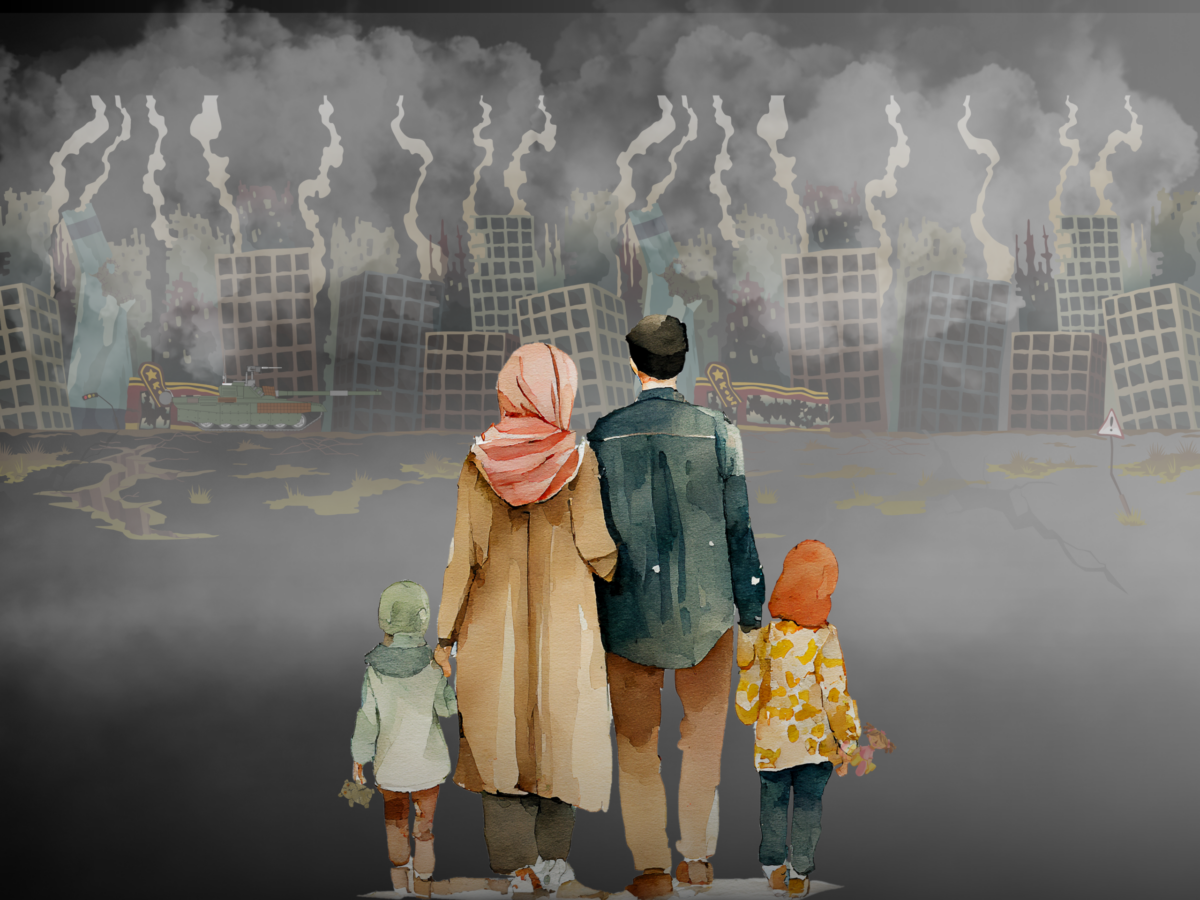
The catastrophic genocide in Sudan during the current civil war could not have taken place without supplies of arms from the United Arab Emirates (UAE). Weapons also come from China and Russia. Sudan has valuable raw materials, and the UAE covets Sudanese gold and is supplying arms to the forces which control gold mines. Egypt and Turkey both provide weapons to the opposition.
The UAE manufactures weapons but the UK is also implicated. In the autumn of last year there was evidence that UK military equipment which was sold to the UAE was being used by one side, the Rapid Support Forces (RSF), including training target equipment from Militec, a Welsh company, and engines for the Nimr armoured vehicles made by Cummins UK Ltd. A year before this, the UK government was given information about the destination of UK arms, but, unsurprisingly, did not act to put a stop to it. In fact they increased their sales to the UAE, sales which included notable quantities of components for armoured vehicles. The west of course considers the UAE an extremely valuable customer, has failed to hold the UAE to account or attempt to bring the horrific deaths and destruction in Sudan to an end.
During the colonial era from 1899 to 1955 Sudan was ruled by both Egypt and the United Kingdom, which was the dominant power, until the country became independent in 1956. Since that date Sudan has experienced long-term instability and has suffered from 20 attempted coups, seven of them successful. There has been lengthy military rule and two civil wars. Two years ago on 15 April 2023 another civil war broke out and led to the Darfur genocide. There was violent conflict and a vicious struggle for power between the army of General Abdel Fattah al-Burhan, the country’s ruler and head of the Sudan Armed Forces (SAF), and the powerful paramilitary group the RSF. The RSF grew from the notorious Janjaweed militia which was responsible for genocide in Darfur in the western Sudan in the 2000s. More than 150,000 people are thought to have died and approximately 12 million are displaced as they have fled their homes to escape the violence. Over four million people have fled to Chad, Ethiopia, Uganda and southern Sudan where the refugee camps are overwhelmed. More than 33 million Sudanese people are suffering in what is likely to be the world’s largest hunger crisis. Meanwhile, what food stocks exist are dwindling and the devastation in the Middle East means that any imports are affected by disruption in the Red Sea.
In October last year the RSF carried out ethnically targeted killings of non-Arab groups, horrifying sexual violence and enforced disappearances during their takeover of El Fasher in Darfur region. So much blood was spilled that it could be seen on the ground from space. A UN fact-finding mission said their actions show the “hallmarks of genocide” against the Zaghawa and Fur communities and warned of the risk of further atrocities. Neighbouring Kordofan is now enduring violent conflict. Amnesty International stated, “The war has been characterised by relentless and brutal attacks on civilians”.
The world has clearly failed the citizens of Sudan and much of the world’s press has failed to report on the killing and devastation which the United Nations described as “the world’s largest humanitarian crisis” and which a number of organisations in addition to the UN have described as genocide.
Some Sudanese citizens who are living in Germany have been horrified by events and extremely disappointed by news coverage. A young Sudanese woman, Aya El Sammani, who now lives in Berlin reported in 2024, “While I’m talking to you right now, there are armies of soldiers who are staying at my home, in my room, and I cannot go back there. I mean I can’t even enter my street…Everything has been stolen in Sudan. Every personal thing, cars, I mean you can even go to your house, and you can’t find your furniture anymore.” Hager Ali, a political scientist at the German Institute for Global and Area Studies, agrees that the conflict has been overlooked by the media. She says,”There’s a very big storytelling issue with the war in Sudan. It’s not something that you can very easily just summarise into a war between good and evil or democracy and autocracy. That limits how it’s covered internationally.” Hager also believes that there is a false perception about this war, that it does not affect politics outside Sudan and that it is not critical in terms of the world’s economy, therefore it is not worth reporting. Some believe that news from Africa is regularly overlooked and matters very little.
On 26 February the foreign ministers of the Sudan Core Group at the Human Rights Council issued a statement on the UN Fact Finding Mission’s report on El Fasher. Their statement began by expressing “collective outrage and profound sorrow at the findings”. Also at the end of February, Ireland, Germany, the Netherlands, Norway, and the UK formed a coalition to prevent atrocities and promote justice in Sudan. Human Rights Watch commented that this coalition could be “a beacon of hope….but the countries involved need to be willing to put in the political capital required to stop warring parties and their backers from acting with such blatant impunity.” Now the UK and any other countries that display the same double standards need to make a commitment to an arms embargo on the UAE. Starmer’s tenure as Prime Minister of the UK has been increasingly characterised by hypocrisy, corruption and mendacity, and it is abundantly clear that the aim to to prevent atrocities and promote justice and to claim to feel outrage and sorrow yet to fuel the war by supplying weapons components once again underlines the Government’s commitment to profit and greed rather than peace and humanitarianism.
Aya El Sammani understandably claims that the “other world” doesn’t care about the Sudan crisis. She points out that war is not about numbers. “I mean isn’t it about people who are killed?” she asks.
We need to remember that war is about real people who want to live their lives free from fear, hunger, displacement and slaughter; real people who want an education, dignity and justice and to follow their dreams.
Amnesty International observes that in all the horror and suffering the people of Sudan continue to resist. “Amid communication blackouts and attempts to silence dissent, activists and organisers remain steadfast to their commitment to their communities, arranging mutual aid and support networks.Their resilience is a signal to the world that the dire situation in Sudan is not inevitable. There are things the international community can do to ensure that civilians are protected and do not continue to bear the brunt of this conflict.” Is there any chance Sir Keir Starmer can find enough backbone and sense of morality to take heed of these words and to act?
Discover more from Penumbrage
Subscribe to get the latest posts sent to your email.