
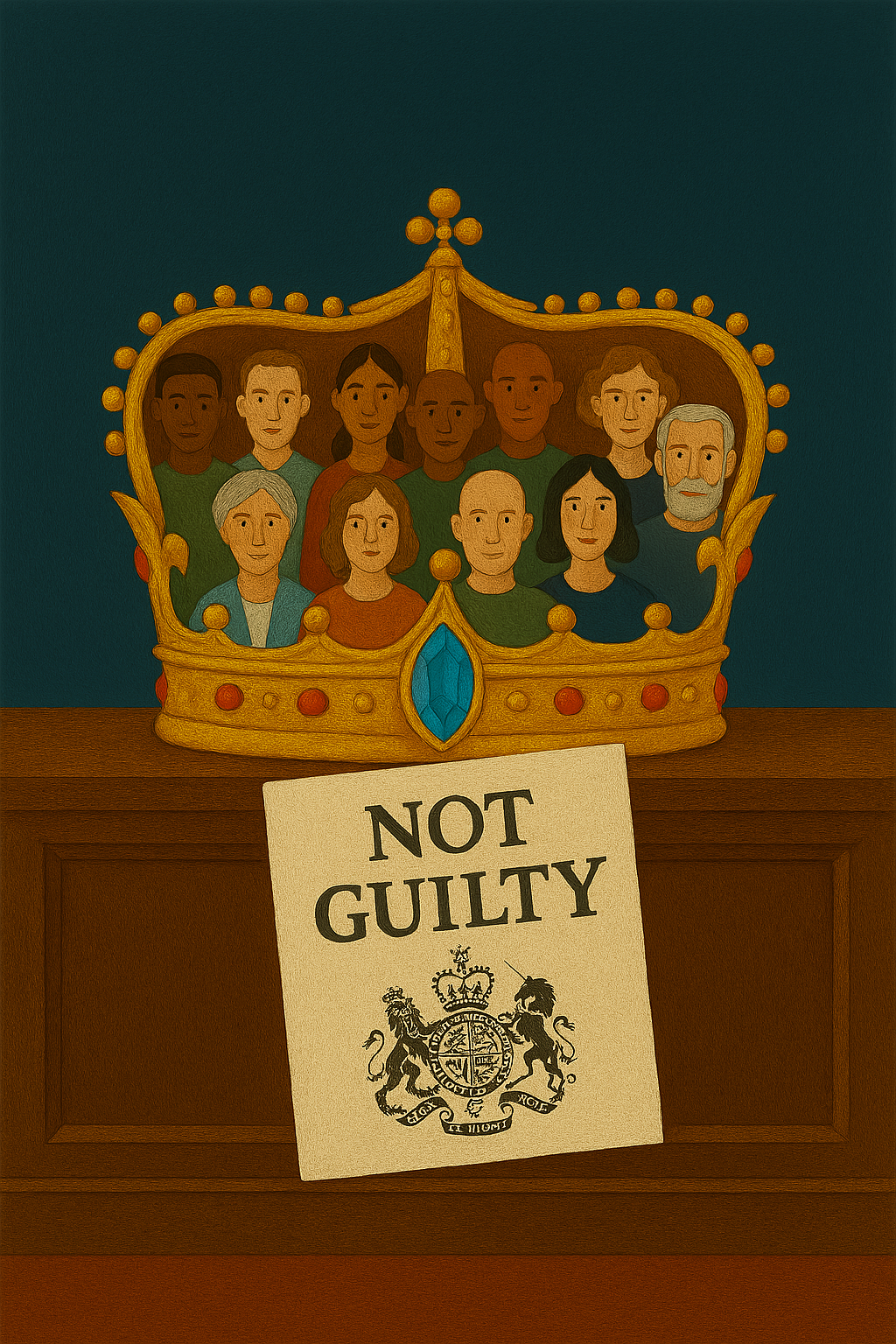
“Jury trial is the jewel in the crown of the criminal justice system in the United Kingdom.” Michael Mansfield, 2024.
In the Old Bailey, the Central Criminal Court in London, there is a plaque to commemorate the 1670 Bushell’s Case. Edward Bushell was the foreman of a jury that defied pressure from a presiding judge and refused to convict two Quaker preachers, William Penn and William Mead. The jurors were locked up without food, water, or heat by the furious judge. But they still refused to give in. Their courage established the principle that jurors should decide on the verdict of anyone on trial. As a result of their bravery, future jurors, rather than a judge, would have the independence to make this decision for those on trial according to their conscience.
Fifteen months ago, I wrote of the 1984 trial of Clive Ponting: “The Ponting case underlines how vital it is to have a jury composed of people who do not have a vested interest in our corrupt, shallow and discredited establishment.”
Ponting was a senior civil servant in Margaret Thatcher’s government. He could not live with the lie that had been told about the sinking of the Belgrano in May 1982 and leaked the papers containing the true information to MP Tom Dalyell. He was prosecuted under Section 2 of the Official Secrets Act in August 1984 and was tried at the old Bailey. Ponting’s legal team expected a prison sentence, especially after the judge directed the jury to find him guilty. The totally unexpected not guilty verdict was sensational. There was applause in court and overall the British public approved that a matter of conscience had proved more important than government secrecy.
An equally famous case was the 1991 trial of Pat Pottle and Michael Randle. They had helped the double agent George Blake escape from Wormwood Scrubs prison 25 years earlier in 1966. They admitted their actions but argued that they were right to help Blake because the 42-year sentence that had been imposed on him was inhuman and hypocritical. The judge gave the jury a clear direction that they must convict the pair, but nevertheless the jury refused to do so.
Much more recently, between 2021 and 2023, there have been several examples of juries acquitting climate protesters of criminal damage at the headquarters of corporations such as Shell and HSBC. The juries made their decisions to acquit the defendants even though judges had told them that the defendants had no defence in law.
In 2023 the Attorney General decided to launch court proceedings for criminal contempt against 68-year-old Trudi Warner who held a sign outside a court reminding jurors that they could acquit climate campaigners on the basis of their conscience: “Jurors you have an absolute right to acquit a defendant according to your conscience.” She risked a two-year jail sentence. In solidarity, 40 people, including an Olympic gold medalist, a retired bus driver, a number of health professionals, a group of Quakers and a former government lawyer, who had all held up similar signs, wrote to the Solicitor General to say that they too should face prosecution. However, in the end a High Court judge threw out the case. Mr Justice Saini said there was “no basis for the prosecution of Trudi Warner, 69, for criminal contempt”.
There have for years been threats to the independence of the judiciary but brave jurors and other individuals have continued to stand up for the principle of jurors’ independence and the right to make decisions based on their conscience.
At the end of last year our Lord Chancellor and Secretary of State for Justice, David Lammy, introduced proposals to impose a substantial restriction on the ancient right to be tried by a jury, arguing that it should only be guaranteed for charges of rape, murder, manslaughter or other cases of public interest. His argument was that such measures would address the backlog of more than 78,000 cases currently waiting for trial. But there has been criticism from many quarters. Riel Karmy-Jones KC, chair of the Criminal Bar Association, commented, “The consequences of their actions will be to destroy a criminal justice system that has been the pride of this country for centuries, and to destroy justice as we know it.”
The government has continued to curtail our liberties and has attacked our freedom in other ways too, clamping down on protests, often influencing the police who, as a result, make uncalled for arrests and sometimes restrict our freedom to march and change an agreed route. Some claims have been made that foreign states are interfering with our judiciary, using their influence with the British Establishment. Middle East Monitor reveals that a heavily redacted document obtained under the Freedom of Information Act indicates that officials from London’s Israeli Embassy tried to exert diplomatic pressure on the prosecution of Palestine Action activists.
The proscription of Palestine Action has proved absurd and outrageous. In November last year, shortly before the Palestine Action Judicial Review case was due to be heard, the appointed judge, Mr Justice Chamberlain, who, according to Defend Our Juries, “was widely respected for his fairness and independence”, was suddenly removed from his position and he was replaced by three other judges. The Electronic Intifada has commented on the change of appointments. There is evidence that High Court Judge Victoria Sharp has close ties to the Conservative Party and is considered pro-Israel. Her twin brother Richard Sharp sits on the board of trustees of a charity which is a funder of pro-Israel groups. Jonathan Cook also discusses the appointments. Dame Karen Steyn was one of two judges who replaced Justice Chamberlain in the F-35 hearing. She and Justice Males ruled in Israel’s favour. Sir Jonathan Swift has a long history of siding with the British state and was the government’s top lawyer. In 2023 he rejected Julian Assange’s appeal against the British government’s agreement to his extradite him to the US for exposing US and UK war crimes. Clearly we depend on juries to maintain balance and make fair decisions.
Some of those imprisoned for direct action against Elbit Systems have been locked up on remand for months. Many of them were kept in prison even before the proscription of Palestine Action as a terrorist organisation. Last week the jury who were sitting on the case of six Filton activists either acquitted them or refused to convict them. We shall remember the names of these courageous young people who risk so much: Jordan Devlin, Charlotte Head, Zoe Rogers, Samuel Corner, Leona Kamio and Fatema Zainab Rajwani. Five of them were released on bail. Sam Corner remains on remand for now. We are hoping that Sam and many other peace-loving activists who have been unfairly detained will now be freed. Typically the CPS asked for more time to decide on whether to press for a retrial. No wonder David Lammy and his allies dislike jury trials, and no wonder we applaud them and need to fight to preserve them.
In recent months the police have arrested hundreds of people for peacefully holding posters expressing support for Palestine Action and their opposition to genocide, while the perpetrators of genocide walk free and often receive plaudits.
Judges are not representative of British society. In 2025 the Ministry of Justice found that only 1% of all judges are Black. 62% of senior judges were educated at a private school and three quarters of them studied at Oxford or Cambridge. Senior judges exemplify wealth and privilege and form one of the most elitist professions in our country. And now, more than ever, we need 12 ordinary people to dispense justice, to act according to their conscience, to challenge judges when they are in the wrong and hold the state to account. Juries give us hope and are a reminder that human beings are generally decent and that a jury of 12 is the best judge of what is right and what is wrong. They are prepared to make decisions against the advice or ruling of a judge when they see that a defendant has been wrongly charged or detained. These jewels are a beacon of light in an increasingly corrupt judiciary.
Discover more from Penumbrage
Subscribe to get the latest posts sent to your email.