
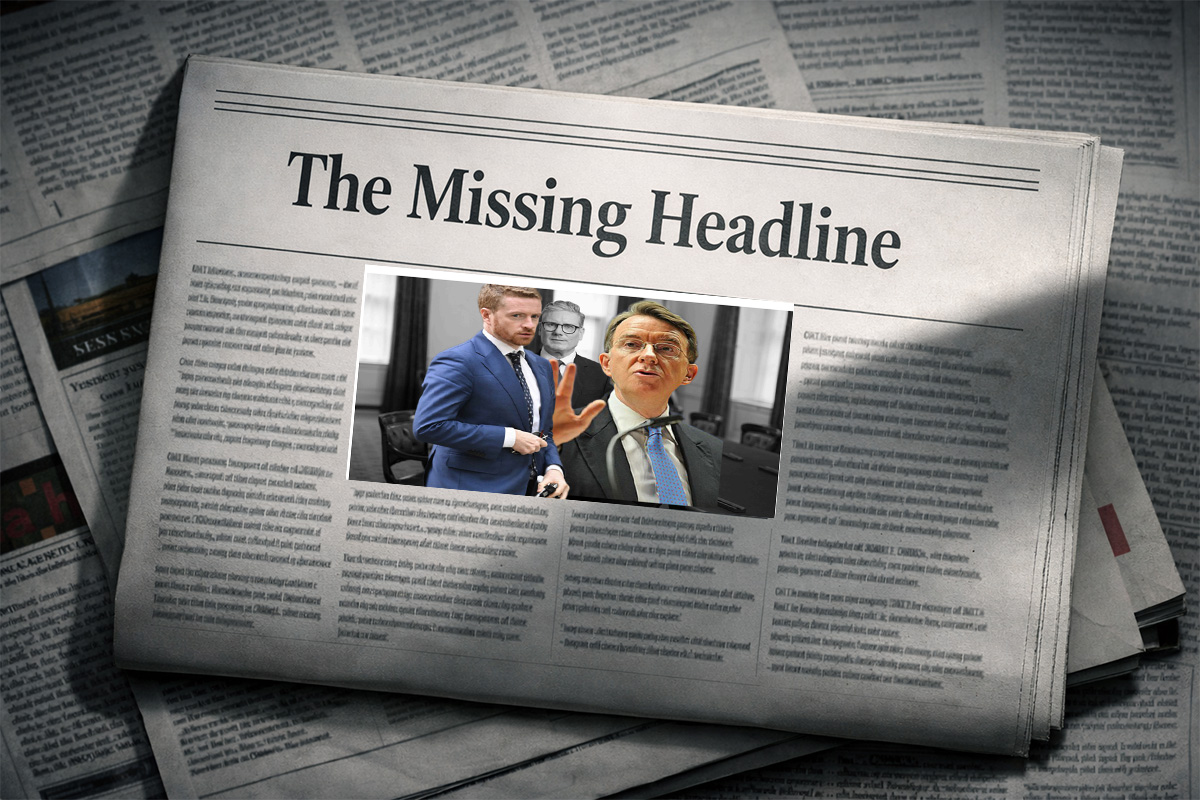
In February this year, I asked the rhetorical question, “Starmer and Mandelson – The Real Reason is Why”? I argued that the then scandal engulfing Starmer caused by his uncritical support of, and dependence on, Mandelson and McSweeney, should come as no surprise to anyone with even the faintest interest in politics. Six months earlier I delved deeper into the murky relationship between Starmer, Mandelson and McSweeney in an article in the now closed Critical Mass magazine – “Starmer’s Crisis of Leadership”, arguing that Starmer didn’t have a political bone in his body, and was merely a stooge for the factionalism that allowed the right, operating through the shadowy political think tank Labour Together, to take over the soul of Labour, destroying Jeremy Corbyn in the process.
Therefore, the reaction to the latest revelation that Mandelson had failed security clearance for his post as ambassador in Trump’s America should really come as no surprise to anyone. Reading that Starmer was “staggered” and found it “unbelievable”, that he hadn’t been told that Mandelson had failed security vetting, is laughable. Even if this was the case, as Diane Abbott questioned in Parliament, “Why didn’t he ask?“ He was, after all, a leading barrister and Director of Public Prosecutions before becoming PM. Questioning forensically and not taking anything at face value is ingrained in anyone from this background.
But, of course, thousands of column inches have already been written on this. Sir Olly Robbins described a very different situation. Robbins told the Foreign Affairs Committee on 21 April that Downing Street made it clear Mandelson “needed to be in post and in America as quickly as humanly possible”. This created what he described as an “atmosphere of pressure.”
Robbins stated that the Prime Minister’s office “didn’t care” about the concerns raised by UK Security Vetting and treated the DV (Developed Vetting) process as something to push through rather than take seriously. He said this attitude “resulted in a dismissive approach to DV.”
We can only assume that the Prime Minister’s Office is a euphemism for Morgan McSweeney.
Despite the ongoing media hysteria around the issue there has been little scrutiny over the elephant in the room. This is the fact that a man with little political conviction or leadership skills was manipulated into a role for which he was little suited to wrench control from the growing popularity of the left. It was left to John McDonnell to point out in Parliament that the Mandelson vetting failure, the decision to override security advice and the reluctance to release documents were not isolated mistakes but part of a “wider culture of internal manoeuvring.”
He reminded MPs that this culture had previously been used against Jeremy Corbyn and his supporters, and that it was now damaging the government’s credibility.
The reality is that Starmer has been at the whim of a very small and shadowy elite, financed by wealthy donors, who all have their own political axes to grind. He has only been able to retain power by displaying a level of ruthlessness not seen in most modern leaders. This has most recently been evidenced by his ability to throw a senior civil servant under the bus to save his own political skin, without apparently following due process. This follows the suspension of at least 15 MPs since the 2024 General Election for:
- voting against government welfare reforms
- rebelling on Gaza-related motions
- opposing trade union legislation
This level of disciplinary action by Starmer is unprecedented in modern times, far greater than that taken by previous prime ministers over similar periods.
More journalists, other than a few operating independently, need to start making links and asking questions. They should look beyond the current controversy and start interrogating and questioning some of the more controversial decisions made by Starmer that have impacted on so many people’s lives including Jeremy Corbyn’s. It shouldn’t be forgotten that Starmer’s leadership was built on a pillar of lies, reflected in the abandoned pledges.
If this episode shows anything, it is that political leadership without integrity is leadership built on sand. When decisions are shaped by factional manoeuvring, donor influence and internal power games rather than principle, the result is always the same: a government that cannot command trust. Integrity is not a luxury in public life. It is the minimum standard. And when leaders forget that the consequences are felt far beyond Westminster.
The result of such systemic political machinations is a trail of damaged lives; a political party fractured in ways that may prove irrevocable and a country that deserved and hoped for so much more.
Discover more from Penumbrage
Subscribe to get the latest posts sent to your email.
[…] Politicians of every stripe have been presented with evidence of an existential threat to human society and cannot even put their names to a call for the government to lead a national conversation! Instead they are obsessed with Putin’s threat to Western Society, or the impact of the Middle East Crisis on the world economy. That is, when they can drag themselves away from damage limitation to their own political careers from the Epstein/Mandelson fiasco. […]