
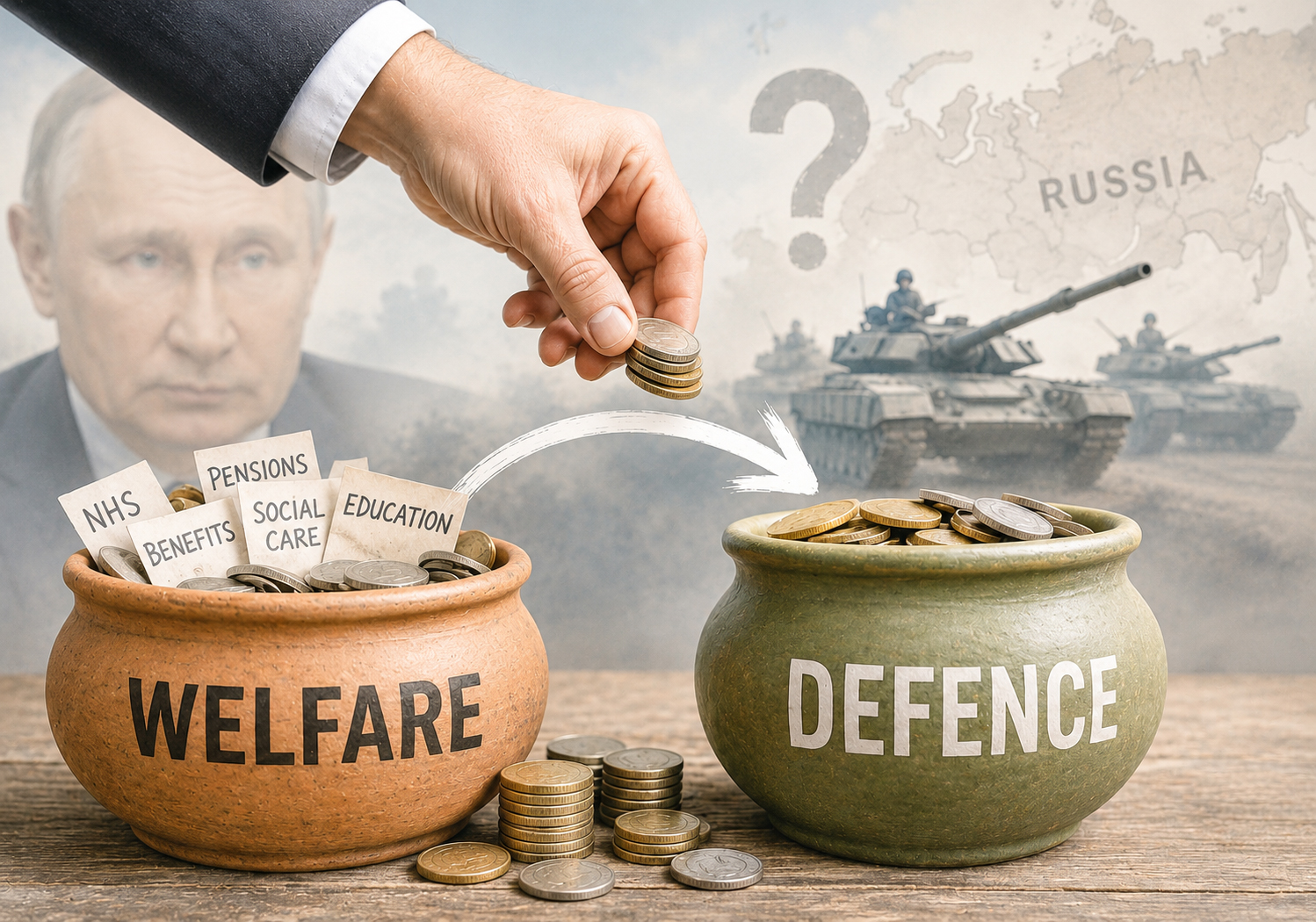
Whatever their political outlook most of the media has been pushing the Russian threat for months now. The narrative is straightforward. Putin’s invasion of Ukraine is the precursor to further Russian expansion into Europe, particularly the old members of the Warsaw Pact, many of whom are now NATO members. If that happens the UK will be drawn into a war with Russia that we are ill equipped to fight. Hence the need to spend more on Defence.
This has resulted in Starmer’s poisoned chalice for his probable successor, Andy Burnham, the Defence Investment Plan (DIP). The DIP represents a massive increase in spending from around £60 billion to £75 billion by 2029. But the catch is that this is not fully funded. Existing budget cuts only cover two thirds of the increase. Burnham will be under pressure to trim his reforming agenda and make more cuts to the existing budget, especially the welfare and benefits bill, to make up the shortfall of £5 billion.
But how real is the Russian threat?
To start with the war in Ukraine. It has been an absolute disaster for both sides. According to Factually
A prominent Washington think tank, CSIS, estimates roughly 1.4 million Russian troops have been killed, wounded, or gone missing since February 2022, including as many as 400,000–450,000 Russian deaths, while Ukrainian military casualties are placed between 525,000 and 625,000 with 125,000–150,000 fatalities through June 2026; CSIS therefore reaches a combined figure near two million military casualties.
These losses cannot be sustained forever by Russia or Ukraine. Eventually there will have to be a negotiated settlement but Western pundits and politicians insist that Ukraine can defeat Russia if we continue to provide enough arms and equipment. If Russia is so vulnerable to defeat in Ukraine how can it also be an existential threat to the UK and its allies in NATO?
Even without the USA’s annual defence budget of $980 billion dollars for arms spending the rest of NATO’s 32 members are spending a combined $626 billion on defence and the UK is the third largest contributor on $80 billion. Compare that to Russia’s annual defence spend of $190 billion. Who is threatening whom? Ever since the collapse of the Soviet Union NATO has been expanding to the East. Economically Russia is not a threat but its nuclear arsenal still counts for something and the USA sees NATO expansion as a way to minimise Russia’s super power status while turning its attention on its new bêtes noires, China and Islam.
I looked at the iPaper’s coverage on Friday and Saturday (3rd and 4th July). They are one of the less partisan newspapers and their masthead reads
IMPARTIAL NEWS + INTELLIGENT DEBATE
Even so they have been publishing articles about the Russian threat and the need for an increase in UK arms spending for sometime now. Recent headlines are instructive. They provide evidence of Russian weakness but still conclude that the Russian threat is growing.
Putin is in danger as Russia’s air defence collapses
Escalating drone attacks by Ukraine have targeted key sites across occupied territory and Russia including road and rail supply routes, oil refineries and airbases.
Putin’s ‘threat’ to Poland is just another sign of his insecurity
Reports of a threat against Poland come after successful Ukrainian drone attacks on key Russian targets.
Putin’s desperation exposed as Russia tricks East Africans into fighting in Ukraine
Lured to Moscow on student or work visas, young recruits are then sent to the frontline as cannon fodder.
Putin needs a mass conscription for war. But it could destroy him
Moscow launched its ‘most massive’ attack on Kyiv overnight, with the Russian president considering mobilising troops to regain battlefield advantage.
It is clear that Russia is not winning and Putin cannot see a way out. But the narrative in the iPaper is remarkably similar to the rest of the media. Putin is in a corner. That makes him more dangerous. He is liable to lash out in an unpredictable manner. He might even unleash Russia’s nuclear arsenal!
The Nuclear Threat
The iPaper wrote about this on Thursday 2nd July suggesting that “Putin’s nuclear option may be to intimidate rather than destroy” with the caveat that “There are fears he might find himself forced to follow through on his threats.” Scary stuff if you just flick through the headlines. Read the whole article and you learn that this threat does not refer to Russia’s long range strategic nuclear arsenal. Instead it refers to so-called “tactical” nuclear weapons, some of which are powerful enough to destroy a small city. Most are much smaller “battlefield” nuclear weapons that could destroy a small town or a large village. Horrific stuff but not as bad as ICBMs devastating the planet.
Russia has 2000 of these tactical weapons. But they have been mothballed since 1990. The warheads would have to be transported by road to their delivery systems. They would have to be recommissioned by a new generation of technicians working from the old manuals and, as they have not been tested for 35 years, there is no way of knowing if they will still work.
Reading the article left me feeling reassured that this was not a serious threat, especially the final sentence:
However, to break the post-1945 taboo would be an extraordinarily risky move on his part, and the warning signs are not yet showing.
But how many people get past the headlines and read to the final sentence? Many people just read the post on social media and never go to the actual article. Long reads do not get read.
19th century philosophers are even less likely to be read, which is a pity because On Liberty, authored by John Stuart Mill and his wife Harriet, but only published in his name after her death, identified a problem within constitutional governments that majoritarian beliefs, encouraged by church and state can lead to dissenting voices being silenced by social pressure. Nowadays the media has replaced the church for most people in the UK at least but the argument remains valid. Not many people today have read John Stuart Mill. But anyone familiar with his contemporary, Lewis Carroll, might remember the Queen of Hearts in Alice’s Adventures in Wonderland saying, “Sentence first—verdict afterwards.”
Think of the anti-Corbyn hysteria, which had no basis in fact, just because he expressed social democratic views that were commonplace before the triumph of Thatcherism replaced the old consensus of a mixed economy with privatisation and blind faith in market forces. Or the idea that retired nurses and school teachers peacefully holding up signs are committing an act of terrorism while race rioters are expressing legitimate concerns about illegal immigration.
It is not Putin who threatens our freedom and democracy. Why would he bother? The authoritarian politics of the Labour government are doing his job for him.
Discover more from Penumbrage
Subscribe to get the latest posts sent to your email.