
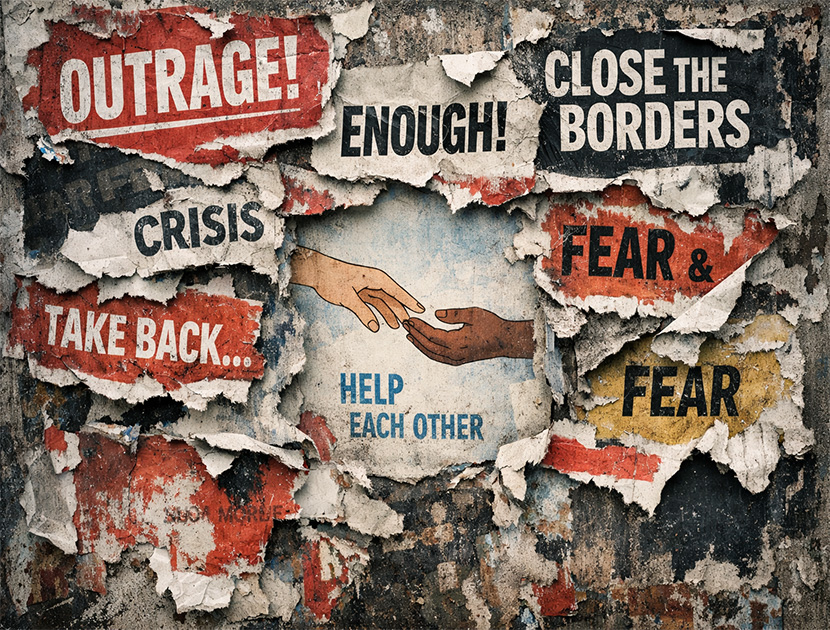
Words have consequences, especially for the victims of racist riots. But apparently not for those who allegedly incite the riots like Farage and Yaxley-Lennon. Last week was difficult for anyone with even a modicum of decency. Watching violent right-wing thugs march and terrorise innocent people following the horrific attack on Stephen Ogilvie in Belfast and the conviction of the murderer of Henry Nowak in Southampton felt as though, once again, the racist underbelly of our country had been exposed. This time though this wasn’t just another misplaced, spontaneous reaction to a tragedy, it was orchestrated by those with influence on the far right in both America and the UK.
The US vice-president, JD Vance, blamed the death of the 18-year-old British student, who was fatally stabbed last year in Southampton by Vickrum Digwa, on the “mass invasion of migrants” and said the “only response” was “righteous anger”.
Nigel Farage framed the disorder in Belfast as an inevitable consequence of a system he describes as having “broken borders.” He claimed that leave to remain is handed out “like smarties,” and announced that a Reform UK government would ban visas for anyone from Sudan with the clear implication that everyone from Sudan is a risk.
Tommy Robinson (Stephen Yaxley-Lennon) shared a graphic video of the incident on social media and used it to heavily criticise UK border policy. He stated that the attack would have “profound implications for community cohesion” and demanded that the government “recognise that uncontrolled immigration needs to end.”
Robinson has also used his platform to share details of upcoming demonstrations, actively promoting calls for anti-immigration protests across Belfast, London, and other parts of the UK.
Angry, racist rhetoric inevitably creates an atmosphere in which hostility, suspicion and ultimately violence become more likely, particularly in those left behind communities where the real problem is poverty and inequality not immigration.
It is difficult to understand why the police, who use the law with enthusiasm to prosecute anyone holding a placard in support of Palestine Action, are not using the powers at their disposal to prosecute those with influence and power like Farage and Yaxley Lennon.
Maybe it had slipped their minds that the UK has a number of laws to prevent incitement to racial violence including the Public Order Act 1986 where it states clearly that it is illegal to use, publish or distribute written material or use words that are threatening, abusive or insulting. It is also worth reminding them that prosecution is likely to be successful if it can be shown they intended to stir up racial hatred or it is likely that this would happen as a result of their actions.
Finally, someone needs to point out that Farage’s promise to ban anyone from Sudan is potentially a clear breach of the law. Generalisations about a racial group become a crime under the Act if the statement is intended to incite others to feel hatred or become hostile towards that racial group based on the actions of a minority. Yaxley-Lennon was detained under Schedule 3 of the Counter-Terrorism and Border Security Act 2019 at London’s Heathrow Airport. All that appears to have happened though is that border control police confiscated his phones and released him without charge.
In contrast, it is striking how rarely the positive case for immigration is made by those with the power to influence and maybe change minds. The public debate is dominated by numbers, boats and borders. Far less attention is paid to the people who staff our hospitals, care homes, schools, universities, transport systems and businesses. The NHS would struggle to function without the contribution of workers who came to Britain from overseas. Entire sectors of our economy depend upon the skills, labour and commitment of people who chose to make their lives here.
Ironically, during his 2020 Labour leadership campaign, Keir Starmer argued that the party needed to make a “stronger and wider case for immigration” rather than merely defending it on narrow economic grounds. He emphasised the social and cultural benefits of migration, advocating for a more positive, human-rights-focused narrative that celebrated the contribution of immigrants to British communities and public services. He, too, seems to be suffering from amnesia.
There is also a tendency to exaggerate Britain’s role as a destination for asylum seekers. While the arrival of people in small boats attracts enormous political and media attention, the numbers claiming asylum remain modest compared with other European countries. The image presented is often one of a nation overwhelmed, yet the evidence paints a more complex picture.
None of this is to deny that some newcomers arrive carrying profound trauma. Many have experienced war, torture, persecution or the loss of family members. Mental health support may be necessary both for humanitarian reasons and for successful integration. Yet anyone tempted to view violence, criminality or dysfunction as somehow imported should spend a single day in a local magistrates’ or Crown Court. There they would witness a sobering truth. Cruelty, violence and exploitation are not the preserve of any nationality, religion or ethnicity. There are human failings found in every community.
There is another dimension often omitted from the discussion. Western nations, including Britain, have participated in military interventions whose consequences have echoed far beyond the battlefield. Wars create refugees. Conflicts destroy homes, communities and futures. When people flee the devastation that follows, responsibility cannot simply be wished away. Displacement is often one of the predictable consequences of decisions taken by governments far from the places where ordinary people suffer the consequences.
The lesson of history is that dehumanisation rarely begins with violence. It begins with language. It begins with the repeated suggestion that some groups are less deserving of empathy, less entitled to protection, less fully part of society than others.
After covering the trial of Adolf Eichmann, Hannah Arendt reflected on what she called “the banality of evil”. Her disturbing insight was not that evil is committed only by monsters, but that ordinary people can become capable of extraordinary cruelty when they stop thinking critically, stop questioning authority and stop recognising the humanity of others.
That warning remains as relevant today as it was then. Before asking why violence occurs, we should ask what stories are being told, who is telling them, and what happens when those stories persuade people that human beings are less worthy of empathy or respect because of the colour of their skin, their religion or ethnicity.
Discover more from Penumbrage
Subscribe to get the latest posts sent to your email.