
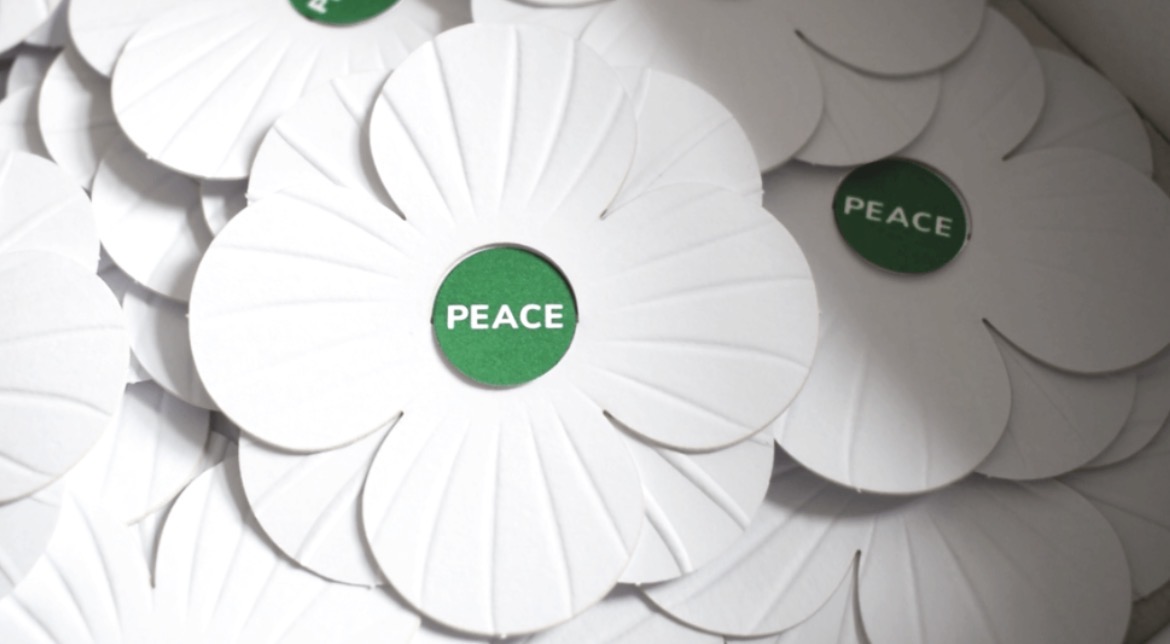
White poppies are for the remembrance of all victims of war. They challenge the glorification of conflict and are a symbol of commitment to peace and non-violent solutions.
“In wearing white poppies, we remember all those killed in war, all those wounded in body or mind, the millions who have been made sick or homeless by war and the families and communities torn apart. We also remember those killed or imprisoned for refusing to fight and for resisting war…. suffering does not stop at national borders, and nor should remembrance.” The Peace Pledge Union (PPU).
The PPU works towards bringing current conflicts to an end and preventing future wars. They argue that it is a matter of urgency to highlight the devastating effects of war, to discover nonviolent solutions to conflict, and to work for peace. “A temporary absence of violence is not enough. Peace is much deeper and broader than that, requiring major social changes to allow us to live more cooperatively.” As well as challenging the glorification of war and the justifications for it, the PPU asks us to question why war has become normalised and clarifies that the symbolism of the white poppy represents “remembrance for all victims of war, a commitment to peace and a challenge to the attempt to glamorise or celebrate war“. They stress the importance of including victims of war from long ago to the present day, those who suffered in colonial conflicts, civilians and all nationalities. This is in marked contrast to the Royal British Legion. The Legion does not accept that remembrance should include combatants of all nationalities, although since 2019 civilians are included.
War is so often about competition for resources, inequality and poverty. It is surely both just and logical to focus our attention on these serious problems and find solutions for them in order to prevent further slaughter. But large sums of money can be made from war and there are huge profits for defence contractors, energy giants, large financial institutions, and security and reconstruction companies.
The first white poppies were created in 1933 by the Women’s Cooperative Guild to promote a pacifist message. Many members of the Women’s Cooperative Guild had experienced the deaths of loved ones, fathers, husbands, brothers and sons, in World War One.The Guild’s General Secretary was Eleanor Barton. She made a statement calling for “that ‘Never Again’ spirit that was strong in 1918, but seems to grow weaker as years go on”.
The Women’s Cooperative Guild was dedicated to promoting international peace and had become concerned that the symbol of the red poppy was increasingly associated with the rise in militarisation. The Guild decided early on that one of the organisations to benefit from the proceeds of the sale of white poppies was War Resistors International. Meanwhile they assured the public that they were not trying to detract from anything that could contribute to improving the lives of war veterans.”The Guild was most anxious that nothing should be done that would prejudice the help given to disabled soldiers.”
Three years after the first white poppies went on sale, the Peace Pledge Union (PPU) took on the responsibility for them and has continued to distribute them since 1936, although there was a spell in when they were produced more sporadically. White poppies are now made by Calverts, a workers’ co-operative based in East London, specialising in socially and environmentally responsible print design. Now all the white poppies are paper based and recyclable.
White poppies have proved controversial and there has always been opposition from a number of quarters, from the militarist sections of society and others who see it as a sign of disrespect or do not wish to cause offence to the establishment and to those who had fought in wars or had relatives who fought and suffered or died. White poppy wearers have been accused of cowardice and the PPU accused of encouraging conscientious objection and mounting a challenge to our traditional values. There is a sense, encouraged by many in the media, that wearing a red Flanders Poppy is a moral obligation to show our thanks and give honour to soldiers who lost their lives, especially in the First and Second World Wars. The red poppy was chosen as it was a flower found frequently on the Flanders battlefields during World War I.
Today some people still contest the production and wearing of the white poppy on the grounds that buying a red poppy would raise more money for wounded veterans. However, many people who purchase a white poppy also contribute to charities set up to assist disabled soldiers. And those who are now suffering as a result of their experiences in the forces should be receiving generous support from the state. In the words of the PPU: “The UK Government has been slashing the welfare state in recent years while maintaining the fourth highest military budget in the world (2024). It is not white poppy wearers who are depriving British veterans of support; it is the UK government.”
Politicians who promote and profit from arms sales can be seen laying wreaths at the Cenotaph on Remembrance Sunday, a ceremony which still tends to focus on the military victims. Money is always found to promote weapons sales, to increase military spending, invest in nuclear weapons and support wars which are continuing today. Our Government persists in contributing to wars in various parts of the world. It is abundantly clear from the many wars which have broken out throughout history that these conflicts have devastating consequences and fail to achieve lasting peace.
Civilian deaths in conflict have risen sharply recently with a 40% rise in 2024. There have been devastating numbers of deaths and violent acts against women and children. Between 2023 and 2024, approximately four times more children and women were killed in armed conflicts compared with 2021-2022. The United Nations Human Rights Office reported that 21,480 women and 16,690 children were killed in conflicts during the 2023-2024 period. 80% of child deaths and 70% of women’s deaths occurred in the genocide in Gaza.
We must oppose war and confront the perpetrators of all the slaughter and destruction who glorify war and convince so many of us that military spending is about defence and protecting our citizens, whereas every weapon constructed is created for killing.
“War is primarily not about victory or defeat but about death and the infliction of death. It represents a total failure of the human spirit.” Robert Fisk (from The Great War for Civilisation: The Conquest of the Middle East)
Discover more from Penumbrage
Subscribe to get the latest posts sent to your email.