
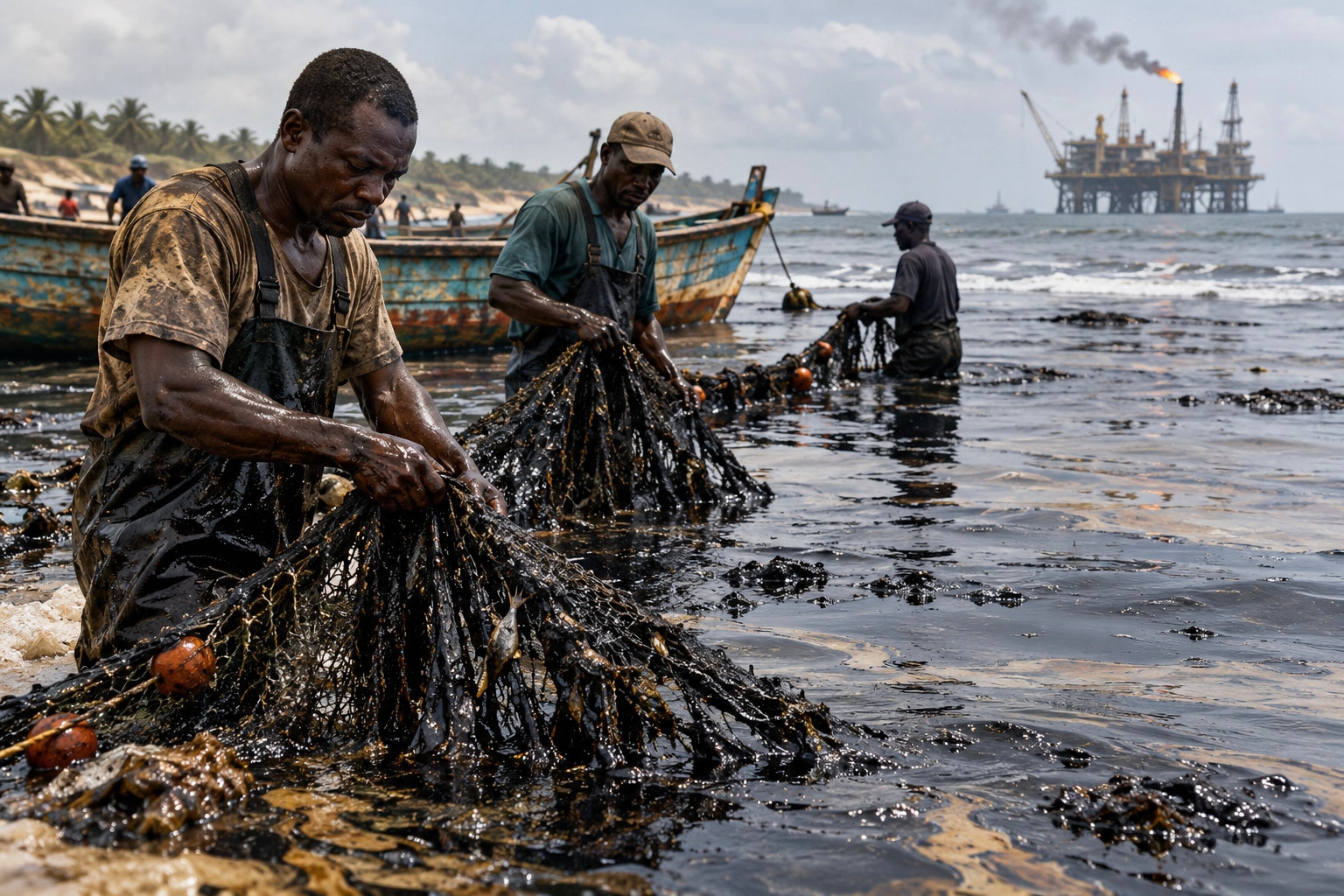
Along the coast of Angola is a rich and varied ecosystem where oil is spilled and there appears to be no accountability. These spills have become routine and the many complaints from local people have been ignored. In addition to the environmental degradation, the spills result in people in the area being exposed to carcinogens and toxic hydrogen sulphide gas. The oil ruins fisheries and hampers fishermen as it clogs the fishing nets. Local fishermen have an informal arrangement to clean up crude oil, which is toxic, but they do not have contracts or health insurance.
There has been a noticeable decline in the availability of fish, which threatens the livelihoods of fishermen and means that one of the main sources of protein is less plentiful. But it is also contaminated. Fish and other food sources have been turned black by the oil, but residents often have no choice but to eat whatever is available. The spills poison essential crops and blacken cassava, oranges and bananas, and dry the coconut trees. One fisherman, João, said, “Our fields are rotten”. When a crop is harvested “it is often already rotten, with insects inside and this fermented smell”. There has been an increase in skin infections, a rise in skin cancer, gastro-intestinal problems and nausea among local people. Declassified UK reports: “The toxic hydrogen sulfide released by the oil extraction activity permeating banana crops is also a breathing hazard. Its sulphurous, rotten-egg odour causes nausea and vomiting”.
The oil spillage scandal has recently been reported by voxeurope, Genocide Watch and by Declassified UK. Genocide watch gives details of the work done over the course of a year to link the oil spills to the oil companies. A cross-border team made an analysis of satellite images, literature and the testimony of experts to make an assessment of the spills and their impact on the area. Satellite images show that leaks have been occurring for at least 13 years, with the first leaks being observed in 2003. The team then made use of trade data, the tracking of ships, the records of corporations and regulatory research. They had the evidence necessary to trace the oil and identify the companies concerned. The culprits are European, British and US oil companies. The area concerned is operated by ExxonMobil and co-owned by BP, Eni, Equinor and Sonangol. They supply 13 countries, including China, India, the United States, Canada, Spain, and Italy. It is brutally ironic that European oil giants pledge a ‘zero-spill mindset’ at home.
ExxonMobil attributes the spills to a natural seep: “Natural hydrocarbon seeps are present across Angola’s offshore waters and predate ExxonMobil’s Block 15 operations….Surveys identified naturally occurring seeps approximately one kilometre north of the Kizomba…. consistent with the observed sheen”. ExxonMobil and its partners were granted an extension to their production licence last year, keeping the operation in the field concerned going until 2037.
Angola’s official record reports a fraction of the likely figures for oil spills. The economy relies heavily on the oil industry providing 60% of the government’s revenue. But the wealth does not benefit local people. More than 53% of Angolans have less than $3.65 a day to live on.
Oil and gas contribute over 80% of Angola’s carbon dioxide emissions, and even a single oilfield can release huge quantities of carbon dioxide over its lifetime.
In the summer of last year, there were protests against the huge jump in the price of fuel, protests which began among taxi drivers and led to the deaths of 30 people and thousands of arrests. The protests highlighted the ongoing awareness and concern about poverty and inequality.
Student Ms Komba commented: “There is huge inequality. Young people in marginalised areas are almost condemned to extreme poverty, without quality education or decent jobs, even if they study hard and earn a degree. These young people think with their stomachs, because hunger leaves them with nothing to lose. The authorities must look at root causes, not just consequences.”
Capitalism has scant concern for the environment, and the pursuit of growth and the extraction of resources leads to pollution and contributes to climate change. Little or no thought is given to creating a sustainable infrastructure. The pollution of Angola’s coastline is more than an environmental scandal. The wealth from the oil along the Angolan Coast is concentrated between owners, shareholders and some of the Angolan elite. It exposes the inequalities inherent in an economic system in which profits can be extracted from a country’s resources, while the people who depend on those resources are exploited and left to contend with the consequences. Local people are marginalised and suffer from the entrenched inequality where their social welfare is neglected. Capitalism inevitably benefits the greedy few to the detriment of the many.
Discover more from Penumbrage
Subscribe to get the latest posts sent to your email.